
Your calm, made visible.
A free breathing space — see how calm you are before and after, and feel the change.
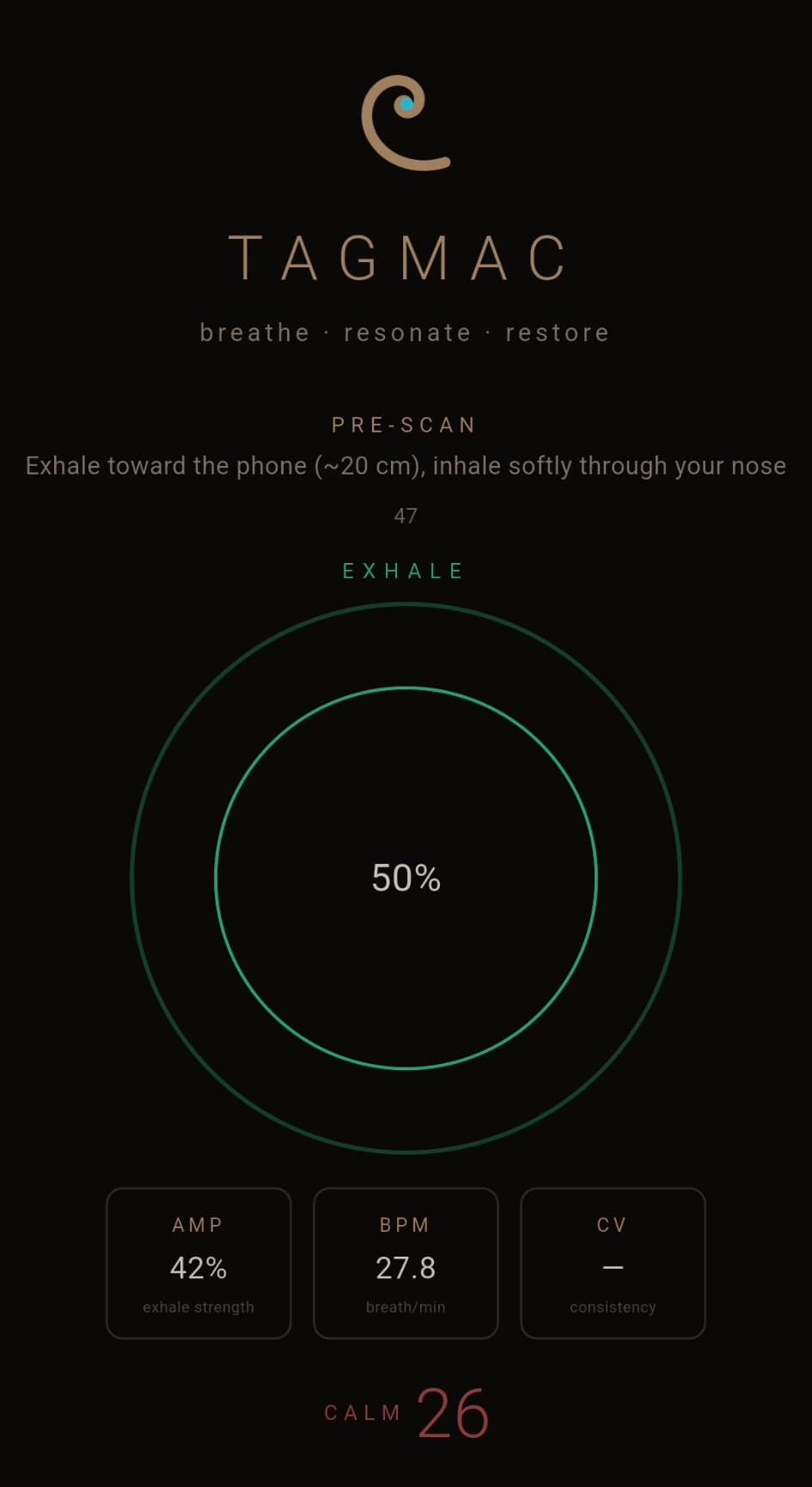
Runs in your browser. No download, no account. iOS & Android coming soon.
How it works
Check in, breathe with the guided pacer — slow, with a longer exhale — then check in again, and watch your calm rise. Keep going and the line climbs week after week. No faith required, just look. You are your own healer; we hold the mirror.
Learn to listen to yourself
Short, sourced explainers — the science behind what the app does:
- How to calm down from a panic attack with your breath
- Why do we sigh when we're stressed?
- How do breathing exercises help with anxiety?
- Why do breathing exercises make me dizzy?
- How to calm down fast — the physiological sigh (research-backed)
- How to calm your nervous system with your breath
- Breathing to fall asleep — the 4-7-8 method
- Box breathing — how to do it and when it helps
- How breathing changes your heart rate (respiratory sinus arrhythmia, explained)
- Why a longer exhale calms you down — and what responsive sound adds
- What is respiratory sinus arrhythmia — and why it's a good sign
- Can you hear your own heartbeat with a stethoscope? — coming soon
Breathing & stress — frequently asked questions
Open the answers →
- Why does breathing reduce stress?
- Slow breathing — and the exhale, which is the breath's calming phase — is associated with a shift toward the parasympathetic "rest-and-digest" branch of your nervous system, which slows the heart and eases the body's stress response. Fast, shallow breathing tends to do the opposite, so deliberately slowing the breath is a lever you can reach directly. [1]
- Why does exhaling calm you down?
- On each out-breath the vagus nerve slows your heart — often called the "vagal brake." Making the exhale longer than the inhale keeps you in that calming phase longer, which is why an extended exhale is associated with lower arousal. [1]
- What is respiratory sinus arrhythmia (RSA)?
- RSA is the natural rise and fall of your heart rate with your breath — faster as you inhale, slower as you exhale. It is normal and healthy, and a window into how responsive your nervous system is. Read the full explainer →
- What is heart rate variability (HRV), and how does breathing affect it?
- HRV is the small beat-to-beat variation in your heartbeat; higher HRV generally reflects a more flexible, adaptable nervous system. Slow breathing — around five to six breaths per minute, sometimes called resonance breathing — is associated with higher HRV. [2][3]
- How do you engage the vagus nerve with breathing?
- Breathe slowly and low into the belly (diaphragmatic breathing) with the exhale longer than the inhale. This pattern is associated with a shift toward the calm, parasympathetic state — no device or supplement required, just the pace and depth of the breath. [1]
- What is box breathing, and does it help?
- Box breathing is inhale four seconds, hold four, exhale four, hold four. It can help downshift stress, though research suggests the main active ingredient is the slow breathing rate rather than the breath-holds themselves. If holding feels uncomfortable, shorten the counts or skip the holds.
- Is breathwork safe?
- Gentle, slow-breathing practices are widely used to lower stress and are very safe for most people. Intense, hyperventilation-style breathwork is a different thing — go slowly, sit or lie down, and stop if you feel light-headed. If you have a heart, lung, or anxiety condition, or are pregnant, check with a clinician first.
- How many breaths does it take to calm down?
- Even a few slow breaths can begin to shift your state, but the effect is more reliable after a few minutes of slow breathing than from any single magic number. Consistency and a slower breath matter more than the exact count or ratio.
Join the launch list
References
- Russo MA, Santarelli DM, O'Rourke D. The physiological effects of slow breathing in the healthy human. Breathe. 2017;13(4):298–309.
- Shaffer F, Ginsberg JP. An Overview of Heart Rate Variability Metrics and Norms. Frontiers in Public Health. 2017;5:258.
- Steffen PR, Austin T, DeBarros A, Brown T. The Impact of Resonance Frequency Breathing on Measures of Heart Rate Variability, Blood Pressure, and Mood. Frontiers in Public Health. 2017;5:222.
Tagmac Wellness is a wellness and self-awareness tool. It does not diagnose, treat, or prevent any medical condition, and it is not a medical device. If you have health concerns, talk to a qualified professional.